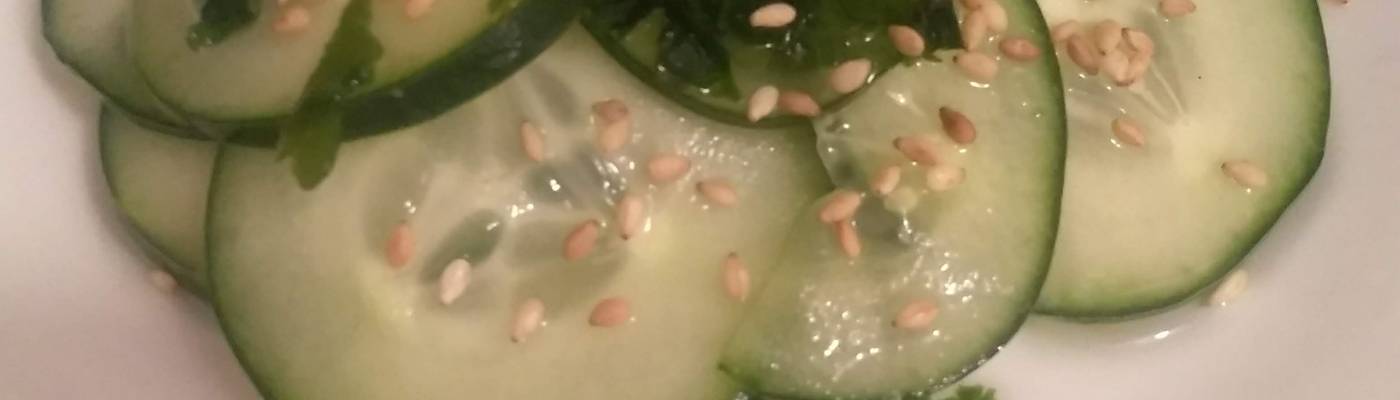
Today we’re going to look at sunomono, which is a class of Japanese pickled salads. Specifically we’ll dive into two varieties that are relatively common in America, the cucumber-seaweed variety and the carrot-radish version that’s often found served with Vietnamese food. Along with the latter recipe I’ve included a simple entree of pan-fried salmon to support the salad.
Cucumber Sunomono
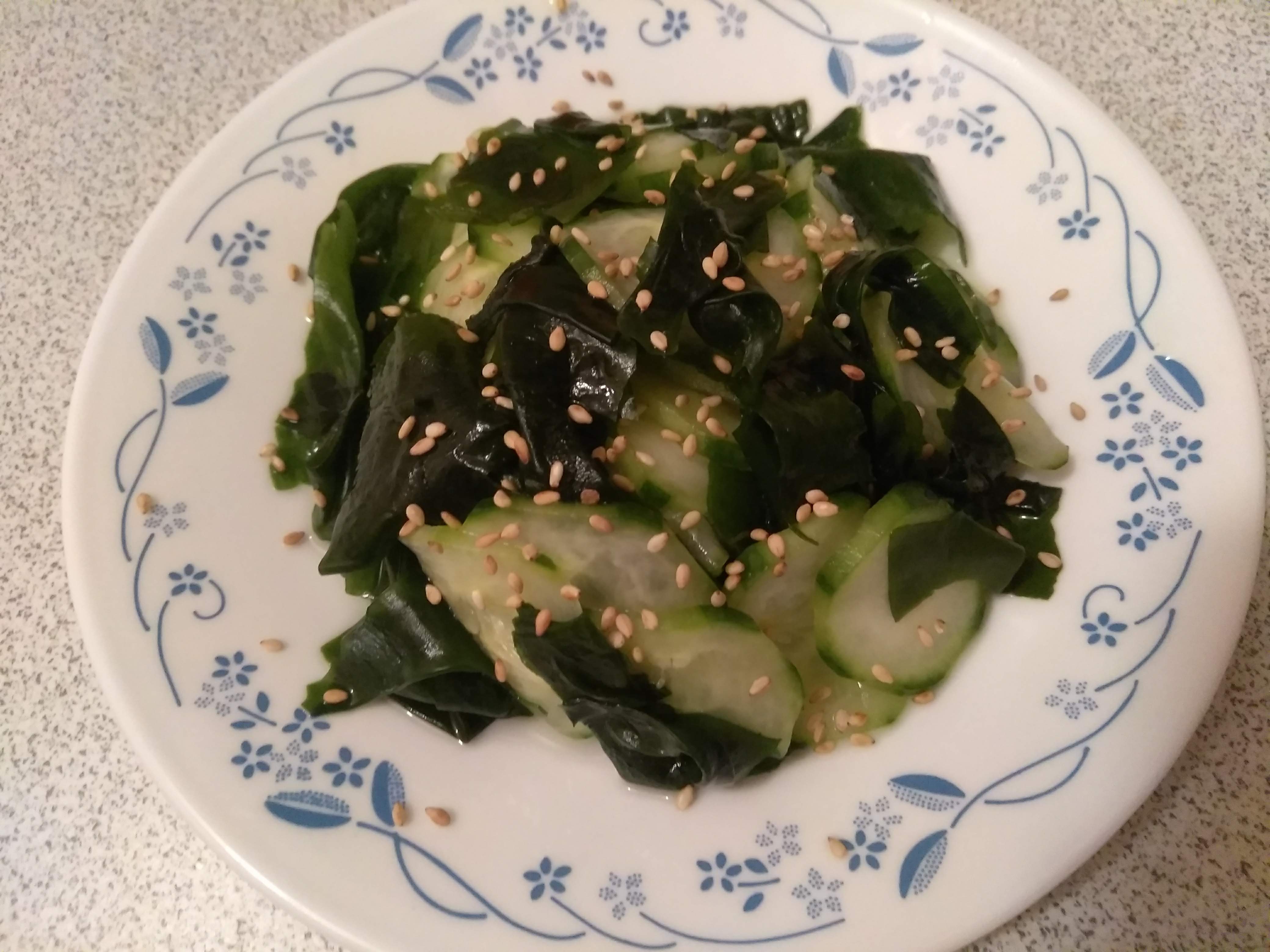
A Japanese salad based on lightly-pickled cucumbers.
Ingredients
- Cucumbers – Persian or English cucumbers are best for this dish as they contain less water and smaller seeds than American cucumbers
- Wakame seaweed
- Sesame seeds
- Rice vinegar
- Water
- Salt to taste
- Optional: Powdered ginger to taste
Directions
- Optional: Completely or partially peel cucumbers for ornamental pattern (shown in photo above)
- Thinly slice cucumbers and place in a resealable plastic bag or Tupperware container
- Add 2 parts water and 1 part vinegar to cover the cucumbers (add more vinegar to make the dish tangier, if desired)
- Add salt to taste and, if desired, powdered ginger or other spices
- Place sealed container in refrigerator for between 10 minutes (for lighter, crispier sunomono) and 1 day (for stronger-flavored sunomono)
- Optional: Crush dried wakame seaweed to make smaller pieces – this helps the seaweed to complement the the cucumbers instead of overwhelming them
- Rehydrate wakame seaweed according to package directions, then place mixed cucumbers and wakame on plate
- Garnish with sesame seeds and serve
Carrot and Daikon Sunomono with Umami Salmon
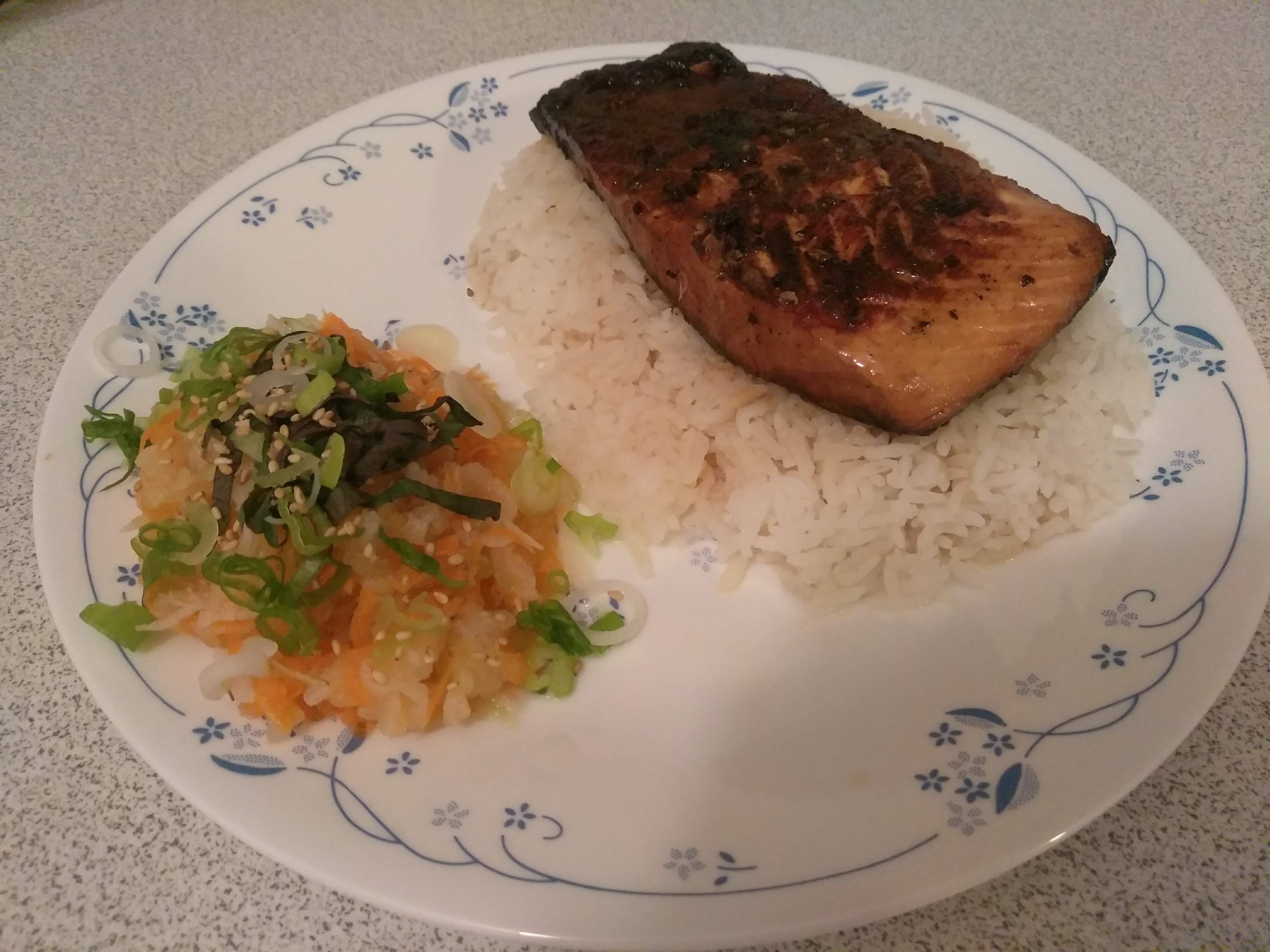
A Japanese salad based on lightly-pickled carrot and radish, served with savory pan-fried fish.
Carrot and Daikon Sunomono
Ingredients
- Carrots
- Daikon radishes
- Green onions
- Sesame seeds
- Rice vinegar
- Water
- Salt to taste
- Optional: Shiso leaves
Directions
- Peel daikon and carrots, then cut into small sticks – julienne-cut or smaller – OR cut into thin discs OR use vegetable peeler to shave into fine strips (pictured above)
- Place daikon and carrots in a resealable plastic bag or Tupperware container (note that if they are pickled together the carrot’s color will run onto the daikon and color everything a bit orange, so if this is important to your preparation make sure to pickle the two separately)
- Add 2 parts water and 1 part vinegar to cover the cucumbers (add more vinegar to make the dish tangier, if desired)
- Add salt to taste
- Place sealed container in refrigerator for between 10 minutes (for lighter, crispier sunomono) and 1 day (for stronger-flavored sunomono)
- Thinly slice green onions
- If using shiso leaves, lay leaves on top of each other and roll into a cylinder, then cut that into narrow strips (pictured above)
- Place mixed carrots and daikon on plate
- Garnish with sesame seeds, shiso leaves, and green onions, and serve
Umami Salmon
Ingredients
- Salmon filets, one per serving – I use frozen filets since I’m in a land-locked state, but this will obviously be better if you’re able to get fresh fish
- Dashi stock – I use Hondashi powder
- Soy sauce
- Mirin
- Rice vinegar
- Rice of choice, cooked using normal rice-cooker method – in the photo above I used regular white rice, but jasmine or nishiki would probably be best
Directions
- Boil water and mix dashi either according to package directions or following your preferred recipe; I prefer to use a mix of soy, dashi, mirin, and rice vinegar
- Heat pan over medium heat
- Add salmon to heated pan, then pour dashi over the fish as it cooks; reserve about 1/8 cup of dashi per filet
- Heat dashi to a boil and cook salmon until the dashi has nearly evaporated; this should roughly coincide with the fish cooking all the way through
- Turn up burner to high and sear salmon on both sides; this will help the dehydrated dashi stick to the fish and give it a nice crispy outer texture
- Place fish over rice on plate and pour reserved dashi over to combine with rice, and serve
Sunomono is an answer to a question I’ve held for as long as I can remember: why do the carrots in Bún thịt nướng chả giò taste so much better than normal? And of course the answer to that is that they’re pickled a bit.
American cuisine is genuinely starved of pickled vegetables other than sweet, dill, and bread-and-butter cucumbers. I’ve learned in the last third or so of my relatively short life about other pickles like okra, asparagus, and mushrooms, all of which are delicious, but none of which tasted quite like those Bún dishes. Realizing that pickling in rice vinegar is A Thing was the missing piece for me – it lets pickles taste sweet without being cloying and gross like American-style sweet gherkins, and goes very well with savory and umami flavors common to several varieties of Asian cooking.
Regarding the salmon, or more specifically the dashi with it, my personal preference is to lean hard on the salty and umami flavors and deemphasize the sweet side of the profile, though a lot of people of course like to add a bit of white sugar to their broth. I’ve found that flavor nice for dipping chilled somen in – a topic we’ll certainly be covering eventually – but I didn’t think it’d complement the already-savory fish terribly well. It’s no Broth Of Vigor, but I find that it does well most of the time.
Dashi is of course a staple of Japanese cuisine and can be used in any number of ways, just like sunomono can go with just about any meal. Another use of sunomono is as an ingredient in other dishes, such as the Bún mentioned above or even just a regular American-style chef’s salad. The tangier cucumbers can really soup up a brick of iceberg lettuce, a steak, noodles, or for that matter anything you please, so make sure to experiment with different vegetables, cuts, and garnishes.

