I grew up around model trains, specifically the ones belonging to my step-grandfather Rodney – and I mean that fairly literally. His train table (more of a full-room set of connected tables and shelves) was a frequent hangout spot for me starting a bit before I learned how to walk. For reasons I genuinely don’t understand, my parents and grandparents indulged my fascination with trains pretty much throughout my childhood to the point that Rodney built his layout in significant part as something to share with me.
I remember crawling around on top of the layout and watching the trains go by. I once got my hands physically on a model of the Jupiter (around $250 in today’s money if I’m not mistaken), which was in real life present at the Golden Spike ceremony, and broke its motor by playing with it like a toy car; Rodney’s reaction to that was to go to the local model shop and ask them if they had any engines that didn’t have motors inside so that I could play without damaging anything. The man was an actual saint.
As the years went by and I entered my teenage years, my interest in the model railroad waned – not my affection for it, but the amount of time I spent with it – and Rodney eventually set it aside, apparently because he no longer had anyone to share it with. Each of us came back to it a few times over the following decade or so preceding his death, but never for very long and not permanently. After he died, my grandmother allowed another grandfather/grandson pair to come in and work on it, but somewhere in there someone set a heavy object on top of one of the control panels, and well…
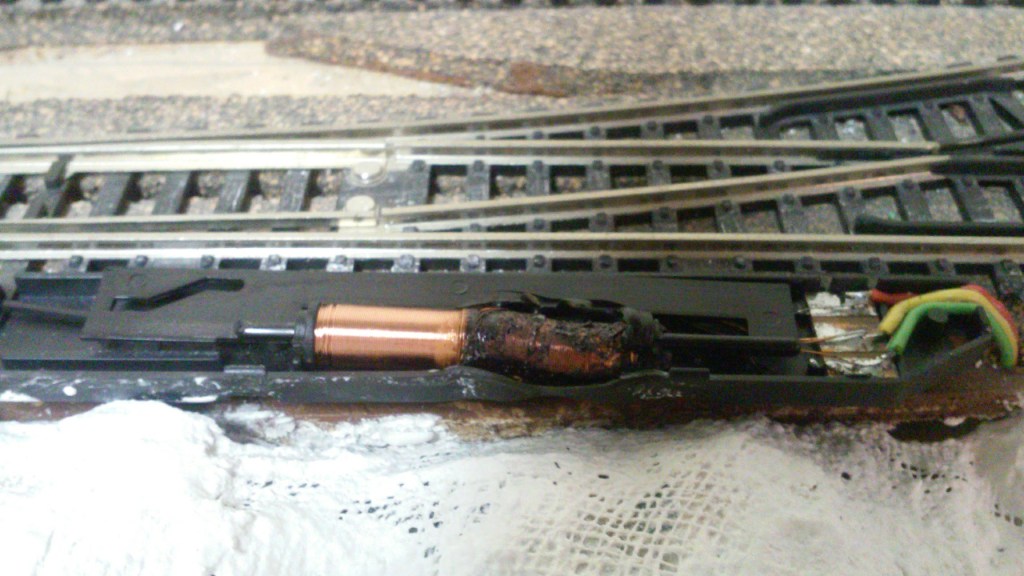
Turns out that switch motors use high wattage in momentary bursts to toggle the position of their solenoids, which means they generate a lot of heat when left on. The result was that several of the motors actually melted, and that along with other less-dramatic damage left the model mostly inoperable.
And, inevitably, when my grandmother was no longer able to live on her own, her house got sold. My extended family came in to help and as part of that process destroyed the railroad, which I don’t think I need to point out was hard for me.
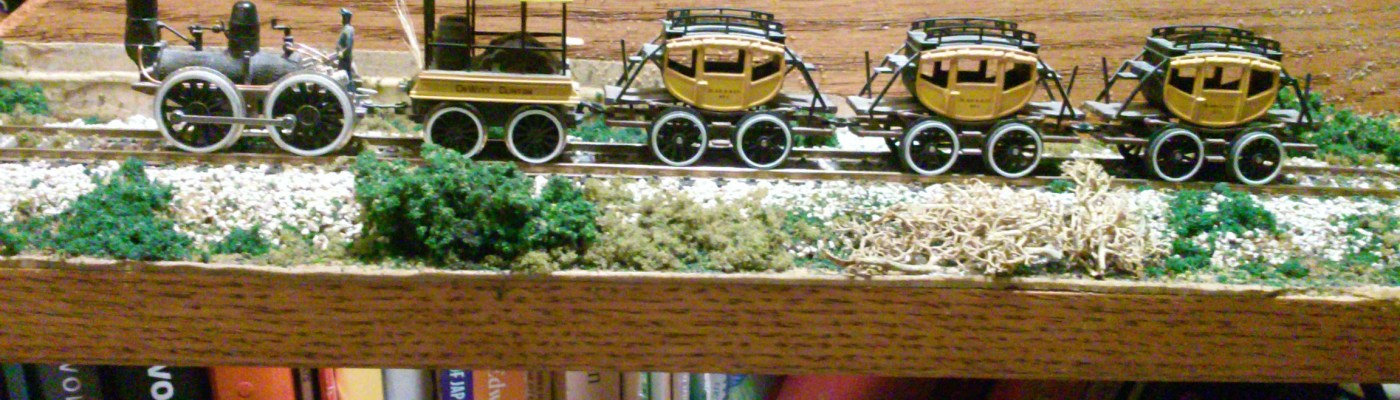
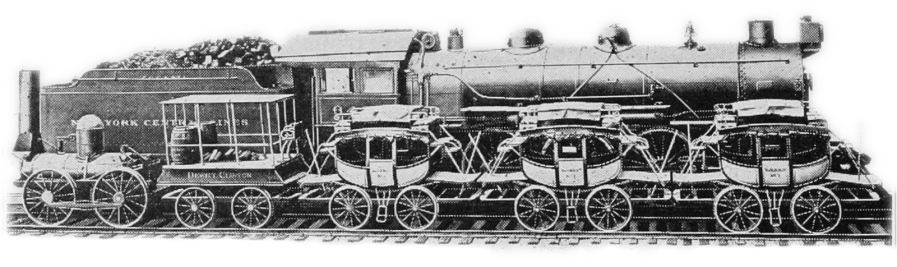
But before all of the dismantling I had a bit of advance notice. Growing up, my grandparents had a shelf in their bedroom with a bit of track laid across it on which Rodney kept a model of the John Bull and DeWitt Clinton locomotives. Ahead of the move-out I got that shelf off the wall and gathered up the supplies Rodney had bought for his layout and never actually used, plus some of the materials I got for my own project.
Model Railroading Toolkit
For this project, I used the tools described in the Model Railroading Toolkit Deep-Dive (coming soon!). Take a look there for more information!
It was thrown together in a huge hurry because of the aforementioned constraints, but I think I came away with at least a partial impression of the terrain Rodney wanted on his layout – and even if the original never came close to completion I at least managed to bring together a small slice of what it could have been.
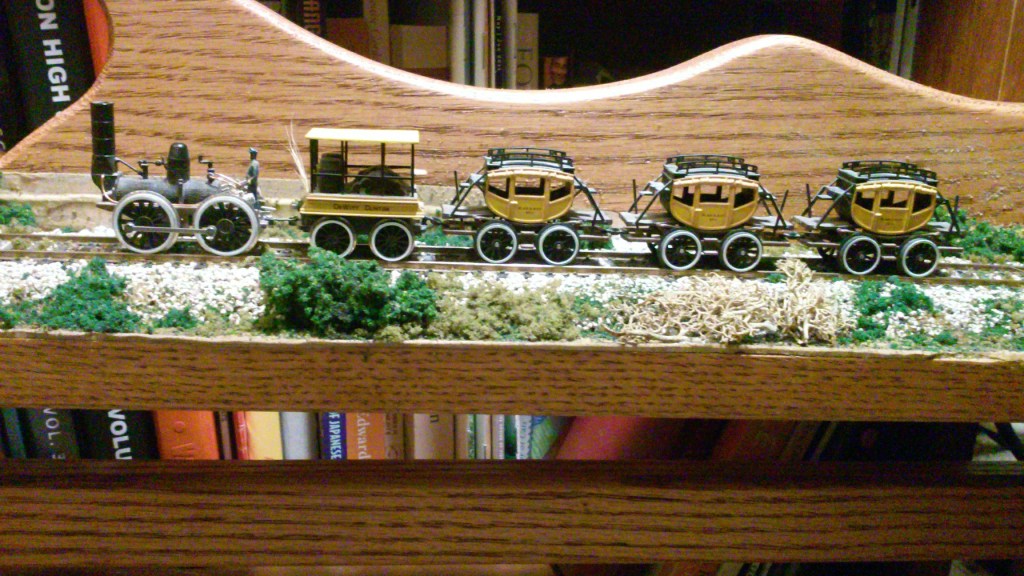
To build this display, I took the existing track over cork roadbed and added some plaster along the front and back. To keep it from getting on the back of the shelf I added a bit of masking tape that only partially came off after the plaster dried. After that I dyed the plaster with Woodland Scenics’ Earth Color pigment and added some fine green blend turf over top. Medium light gray ballast got placed between the ties and the rails themselves were colored with weathering markers to make them a tad rusty.
Then it was time to add some visual interest with coarse light and dark green turf, bushes, talus, lichen, and even a few bunches of field grass. This overall ended up looking pretty busy because of the limited detail I could fit into the narrow shelf, and a lot of the points of interest ended up just being clumps of flocking material, but it still gives a decent overall representative image of the area the diorama could be set in.
During this process I made a few mistakes, most of which aren’t substantial enough to mention – but one of them actually caused me some trouble. When I was making the field grass tufts I made them mostly fairly long and glued up the base fairly far. This is normally a good thing since it helps them to be sturdy. However, I wanted to show the tracks as disused, so I plopped a couple of them down right next to the track. And a sturdy vertical object right next to the tracks isn’t great for actually having things on those tracks. That’s why in the photo below there’s a tuft sitting exactly between two carriages even though that forces the whole train to be off-center.
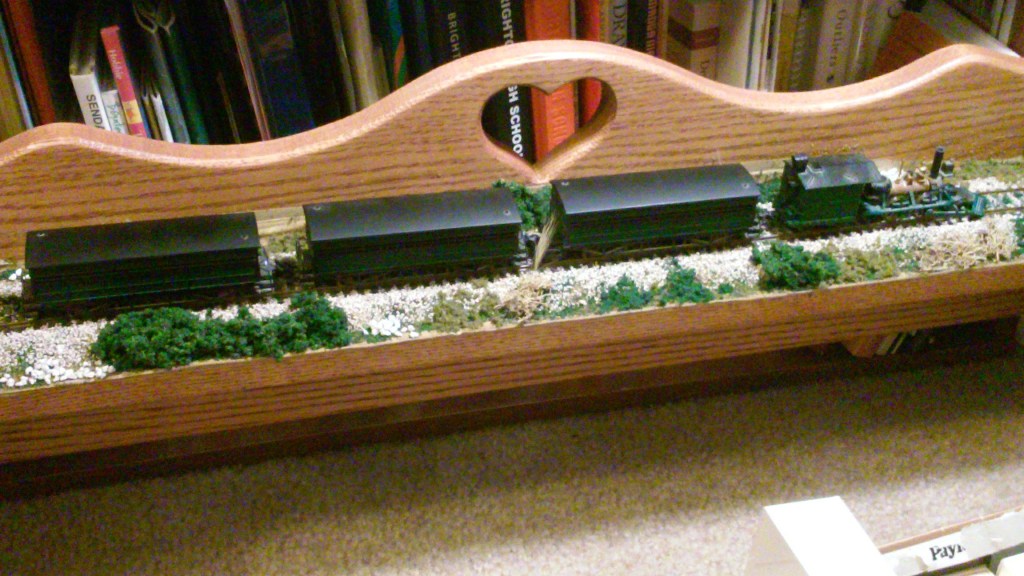
With the work done I posed the locomotives and their respective carriages on the shelf and got some photos before hanging it up in my home office where it lives currently. It’s not much, certainly not as much as I would have hoped for, but it’s enough of Rodney’s layout living in my home as I need for the moment.
 cogthecat's crafts